Working with healthcare professionals.
Could a clearer record of infant crying support better conversations with parents?
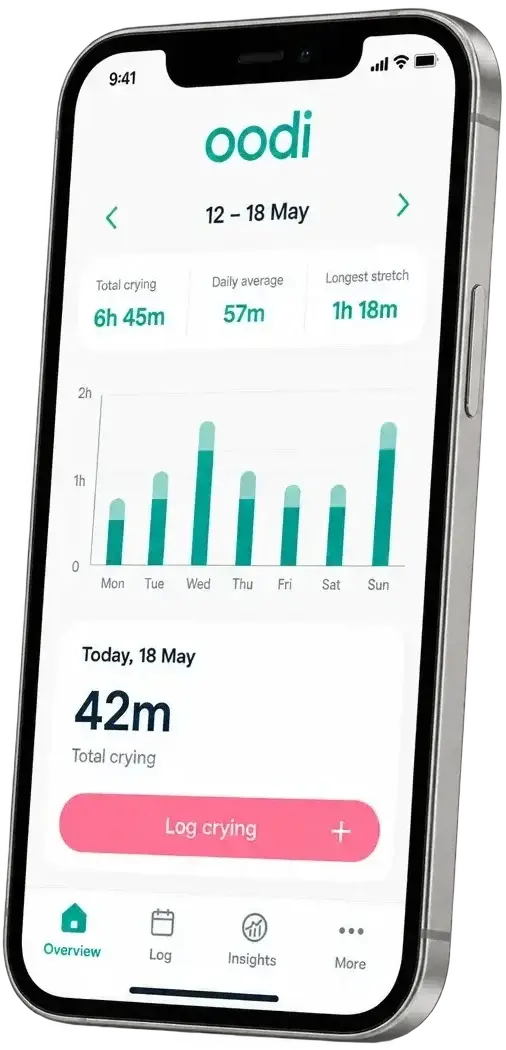
Oodi is a Finnish baby-tech wellbeing product that helps parents keep a longitudinal record of their baby’s crying and see how it changes over time.
We are exploring whether that information could also be useful when parents discuss crying with healthcare professionals.
We’re not asking whether you would recommend Oodi today.
We’re asking a smaller and more useful question:
Would you help us understand what a credible UK feasibility pilot would need to look like?
The problem we're exploring
When a parent is worried about their baby’s crying, the conversation doesn’t begin with perfect data.
It may begin with:
“My baby cried all night.”
For an exhausted parent, that may genuinely be how the night felt.
But understanding what actually happened can require different questions:
When did the crying happen?
How long did it last?
How often did it happen?
Has the pattern changed?
After several difficult days and nights, those questions can be surprisingly hard to answer from memory.
Oodi creates a record that parents can look back on.
The question we want to investigate is simple:
Could that make the conversation more useful?
What Oodi produces
Oodi turns individual crying events into a longitudinal visual record.
Parents can see:
- When crying happened
- How long crying events lasted
- How often they occurred
- How the pattern changed across days and weeks
Rather than reconstructing several days from memory, a parent can choose to bring that record into a conversation with a healthcare professional.
But crying data isn't the whole story
This has been one of the most important lessons from our work with parents and healthcare professionals.
Two babies can cry for the same amount of time.
Two parents can experience that crying very differently.
The number of minutes matters.
But so does the family experiencing them.
A relatively short period of crying may feel overwhelming to one parent, while another family may cope differently with a similar pattern.
That means a graph should never overrule a parent’s concern or become the whole assessment.
- The baby's crying matters.
- The parent's experience matters too.
Context, not diagnosis
Oodi is not a diagnostic tool.
Oodi does not:
Diagnose a medical condition
Determine why a baby is crying
Identify what a baby needs from an individual cry
Classify an individual baby as healthy or unwell
Replace clinical assessment
Replace parental judgement
And a crying graph should never be used to dismiss a parent’s concern simply because the numbers appear unremarkable.
Data can add context. It cannot tell the whole story.
What we're actually testing
We don’t yet assume that having more data makes a healthcare conversation better.
That’s something we want to find out.
For parents
- Does having a record help parents describe what has been happening more clearly?
- Does it help them recognise changes across days and weeks?
- Is the information useful when they want to discuss crying with a professional?
- How does tracking affect their experience - reassurance, anxiety, neither, or something else?
For healthcare professionals
- Is longitudinal crying information useful during a conversation with a parent?
- Does it add anything beyond the parent's verbal description?
- Is the information presented in a useful and understandable way?
- Does reviewing it create additional workload?
- Could it unintentionally increase anxiety or create false reassurance?
- What information would actually be useful - and what would simply be noise?
What we've learned so far
Oodi has been developed through research with parents, input from healthcare professionals and real-world testing in Finland.
Our work has included a survey of 170 parents, with more than 80% reporting that they had experienced uncertainty about whether their baby’s amount of crying was normal.
We have also sought input from healthcare professionals working in areas including neonatology, public health nursing and nursing education.
One recurring theme has been that the parent’s experience cannot be separated from the crying data itself.
A statement such as:
“My baby cried all night.”
contains information about both the baby and the parent’s experience of that night.
Structured data may help clarify the first.
It should not erase the second.
From Finland to real-world testing
During spring 2026, three public health nurses participated in an evaluation with Lapland Testbed exploring how automatically collected crying information could support families and conversations with healthcare professionals.
A further real-world pilot is now underway with the Kaakkuri and Oulunsalo child health clinics in Oulu, Finland.
The pilot is exploring whether a structured longitudinal crying record can add useful information to conversations between parents and public health nurses without creating significant additional work for healthcare professionals.
These are early-stage feasibility questions.
They are not evidence of clinical effectiveness.
What we don't know yet
There are important questions that Finnish testing cannot answer for the UK.
We don’t yet know:
Whether a longitudinal crying record improves parent-professional conversations in a UK setting
Whether healthcare professionals would find the information useful in practice
What information should - or should not - be presented
Whether tracking could create unintended reassurance or anxiety
What governance, privacy and data requirements a UK feasibility pilot would need
How Oodi could fit alongside existing UK services, guidance and pathways
or whether Oodi ultimately has a useful role in this setting at all.
We’d rather test those questions than assume the answers.
Why we're coming to the UK
Oodi is launching to UK families at The Baby Show Olympia London, 23–25 October 2026.
Consumer market validation is one reason we’re coming.
But it isn’t the only one.
We would also like to meet UK professionals who can challenge our assumptions and help us understand what evidence would actually be required before making stronger claims about Oodi’s potential role in healthcare.
We’re particularly interested in speaking with:
- Health visitors
- Midwives
- Child-health and paediatric professionals
- Researchers and universities
- NHS and service-innovation teams
- Organisations evaluating digital tools for parents and families
You do not need to be interested in adopting Oodi.
A critical professional perspective is valuable to us too.
Help us answer the next question
If you work with new parents, infant health, research or service innovation, we’d like to hear from you.
We’re particularly interested in exploring what a small, credible UK feasibility pilot would need to demonstrate.
At The Baby Show?
Come and talk to Satu and Erasmus at Stand NK20.
Let's talk
Satu Niemelä
COO & Co-founder, Oodio Oy
- satu@oodi.tech
- +358 40 536 3486
-
Oodio Oy · Oulu, Finland
oodi.tech